
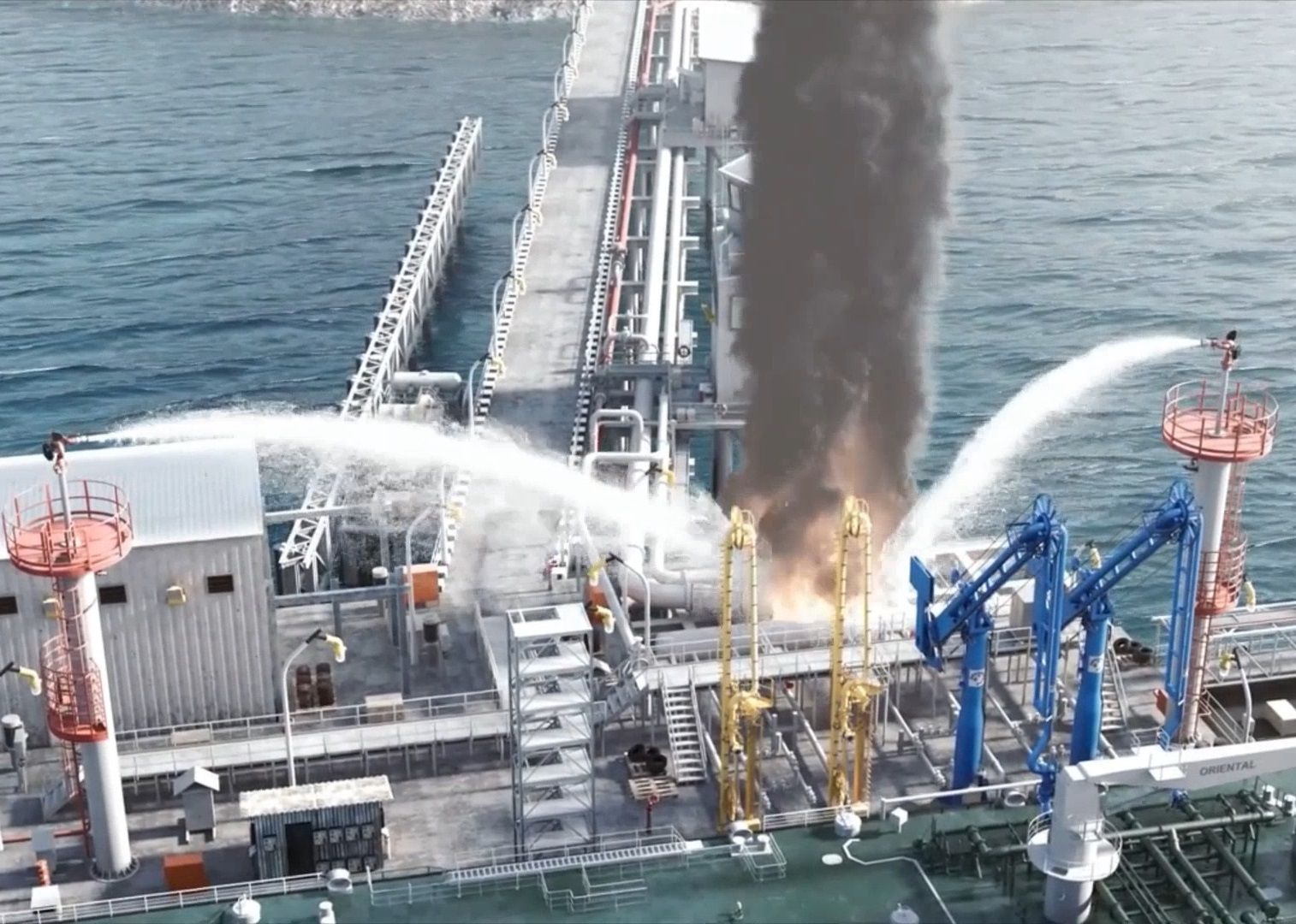
Remote Controlled Fire Monitor
Safety is of particular importance in the port industry, including shipping, unloading and loading.The high risks and hazards inherent in petroleum products due to their incendiary properties require careful identification and assessment, and risk management makes this a requirement for the joint operation of a tanker and terminal.
Equipment Range Criteria:
In the event of a fire, fire fighting equipment should be considered to minimize negative consequences and extinguish.
According to the classification in the regulations, oil terminals are divided into three categories in terms of fire safety.
Category I ve II: The fire protection philosophy for this terminal group is to cut off fuel transfer to the fire. So, the process equipment is turned off and the process is isolated.
In this case, the dock, transmission equipment and ship manifold are cooled until the fire is under control. A foam system is used to control the fire.
Category III: The protection philosophy at these terminals is the use of portable fire extinguishers for small fires and reliable port fire system in case of a major fire.
Three elements are vital for a fire to emerge and continue:
- Fuel
- Heat
- Oxygen
For fire, it happens when these three elements come together to create a spark.
Possible causes of sparks at oil piers:
- Smoking: In this context, staff are required to comply with strict safety instructions for smoking and lighting any flames.
- Non-proof Lights.
- Electrical equipment: Hazardous area conditions should be considered in the selection of fixed and mobile electrical equipment.
Fire fighting philosophy:
The philosophy of firefighting is to eliminate one of the three causes of fire.
There are two strategies in firefighting:
- Cooling of surrounding equipment (removal of heat source) to prevent the spread of fire.
- Extinguishing the fire by covering the fire with suitable materials such as fire foam to prevent oxygen from reaching the fire and to prevent the continuation of the combustion chain.
The first step to fighting a fire is activating ESD valves with fire alarm systems or a central control system.
Fire Fighting Equipments
Firewater Pumps
Fire water supply is unlimited due to the location of the oil piers by the sea. (Otherwise, 4 hours of fire water must be provided).
Features of fire pumps:
- These pumps must be able to supply fire water at a pressure of 125 psig.
- In addition to the main pumps, standby pumps should also be considered in the design.
- Main electric pumps and standby pumps are independent supply source (Diesel driven).
- Continuous positive suction must be provided for the pump.
- Fire fighting equipment (fire water pipes) should be used.
Features of fire water pipes:
- The design of the fire water pipe network should be made in such a way that in case of any malfunction in the system, it will not be destroyed from a distance of more than 300 meters. Isolation valves are considered for different bolts.
- Piping is done in such a way that there is no possibility of fire, that is, preferably on the pier deck. If passing under the scaffolding deck, fire prevention actions must be taken.
- If it is possible for the air temperature to drop below zero degrees, the lines must be traced or insulated.
Foam Monitors:
Spraying foam on the fire prevents oxygen from reaching the fire and extinguishes it. Therefore, one of the important equipment on firefighting oil piers are foam monitors (fixed or elevated).
According to the standard:
1- Monitors must have a throwing power of 30 meters and should be placed at least 15 meters from the equipment.
2- Monitor activation valves should be located at least 15 meters from the equipment.
3- Fixed foam equipment should be at least 60 meters away from the nearest anchor.
Coverage range and foam feed rate:
Due to the height of oil pier equipment such as loading and unloading arms, it is necessary to use monitors mounted on fire towers.
Foam Tanks:
- Foam is provided by foam trucks or stationary foam storage equipment.
- Fire foam is a polymeric material mixed with 3% to 97% water and is applied as a foam solution on fire after the foam is ventilated from the monitor’s aspuraysan device.
Fire Detection and Alarm Systems:
- The selection and location of fire detection equipment depends on process material risk, tanker size and terminal location.
- Since heat is transferred by convection, the effects of natural and mechanical ventilation on the space must be taken into account. For other detectors, such as flame detectors, the flame must be taken into account by the detector.
Types of detectors used in oil piers:
Fire Detectors:
These detectors are often used in high-risk locations such as switchboards and control rooms. This equipment is also mounted on the loading arm and other process equipment where there is any possibility of sparks as well as the possibility of leakage. These detectors reside in a network and their function is to alarm only if the first detector is activated; is the activation of the fire system if the second detector is activated.
Fixed Combustible and Toxic Gas Detectors:
These detectors are installed to detect the presence of hydrocarbons in the air (indicating equipment leaks). This equipment is used where there is a lot of personnel traffic or where proper ventilation is not possible. At oil docks, consideration should be given to equipping the loading arms and manifolds of valves and pumps with this type of detector.
The detectors used can give audible and visual alarms.
There are two possible possibilities for these detectors to work:
It activates the fire detection system automatically and through the transmitted signals the installed fire system. In addition, the location of the fire detection can be seen from the control panel. This type of activation is intended for offshore terminals or where manual activation is not possible or dangerous.
The fire detection system only gives an audible and visual alarm and the location of the fire in the control room is determined. The fire system is then manually activated.
Risk and consequences analysis
Quantitative and qualitative analysis of accident results such as combustion is made by modeling with PHAST software.
The results based on the different scenarios identified determine the probability of deciding the location and operation of the equipment.
The software is modeled and the results analyzed based on the definition of the percentage of process material, operating conditions including temperature and pressure, weather conditions and… as well as the definition of the fire scenario.
By analyzing the results, the possibility of checking the performance of the equipment during a fire is investigated and concluded.
Disadvantages of manually installing the fire extinguishing system
With the explanations given regarding the risk analysis model, the use of operative and manual firefighting equipment, considering time as an important factor due to the high risk of fire causing damage and contamination to other equipment, radiation exposure from fire during firefighting operations is a risk for the operator. creates risks and puts firefighting operations at risk.